

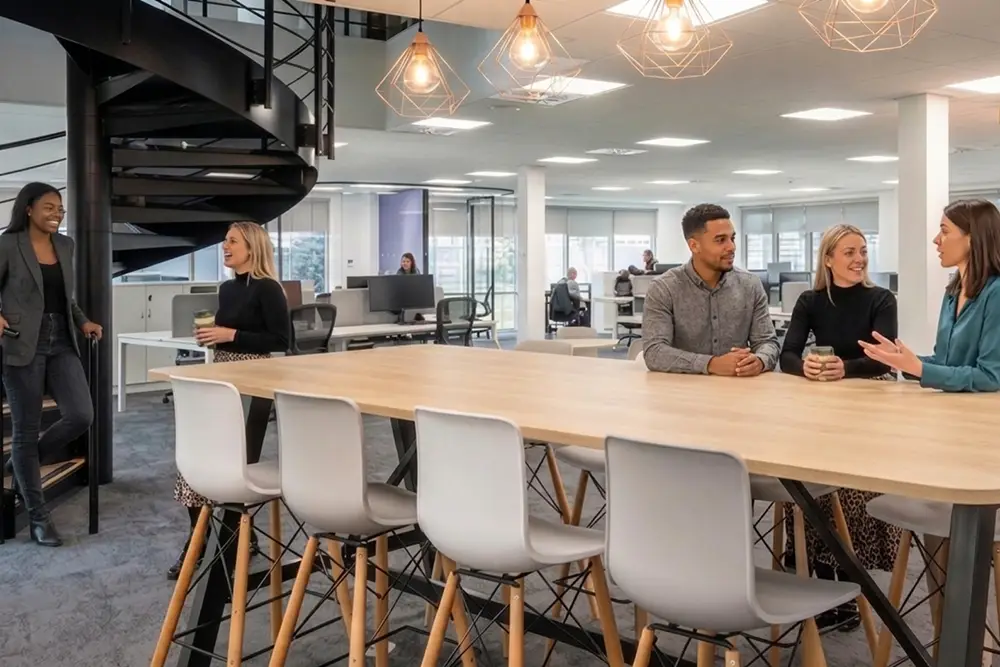
Office design for collaboration: Designing a workplace people actually use
Designing a workplace people actually use
This month, we celebrate National Tea Day, which on the surface has very little to do with workplace design, strategy, or performance. In reality, we think it reveals more about how a workplace truly works for the people that use it every day.
What office design for collaboration really looks like
If you want to understand whether a workplace is really working, not just how it was intended to work, but how it is really being used day to day, you don’t start with the floorplan, you start with the kettle. Think about the first thing you do when you get into the office in the morning, or the first thing you do when someone visits your workplace…you offer them a cuppa.
Where people make tea (or where they make coffee in Director Chris’ case) is one of the most honest indicators of how a workplace performs because it captures natural behaviour without anyone consciously thinking about it.
What your office kitchen design says about your workplace
Do people gather in your kitchen area, allowing conversations to happen naturally, or do they move through it quickly, treating it as a purely functional stop before returning to their desks?
Does the kitchen area create opportunity for interaction, connection and small moments of collaboration? Or does it feel like an afterthought, tucked away and disconnected from the wider flow of the office space?
An interesting but often overlooked truth is that office design can support collaboration, not always in the spaces we plan for, but in the ones people naturally drift towards.
The power of informal interaction
Let’s be honest, people watching is one of life’s guilty pleasures and a top tip to learn about how your space functions is to take a moment to observe your office breakout areas where those cuppas (be them frothy, black, decaf or herbal) are being brewed.
You will often learn more from observing that one space than you will from reviewing an entire workplace strategy document. Workplaces are shaped by the small, everyday moments that sit in between daily tasks, plans and presentations.
- The short conversation that happens while waiting for the kettle to boil (unless you have a snazzy boiling water tap of course, but even then, the act of making that cuppa serves the same purpose), which then turns into a quicker and more effective resolution than a scheduled meeting ever would have achieved.
- The unplanned interaction between colleagues who don’t usually sit near each other, which sparks an idea or removes a blocker without it ever being formally recognised.
- The brief pause between meetings where someone has the space to think clearly, reset and approach their next task with more focus.
These moments are easy to overlook because they don’t sit neatly within your office layout plan. They are where your office culture shows up, where relationships strengthen and where work often moves forward most effectively, yet they are rarely given the same level of intent when designing a collaborative workspace.
Why breakout spaces and shared areas matter more than you think
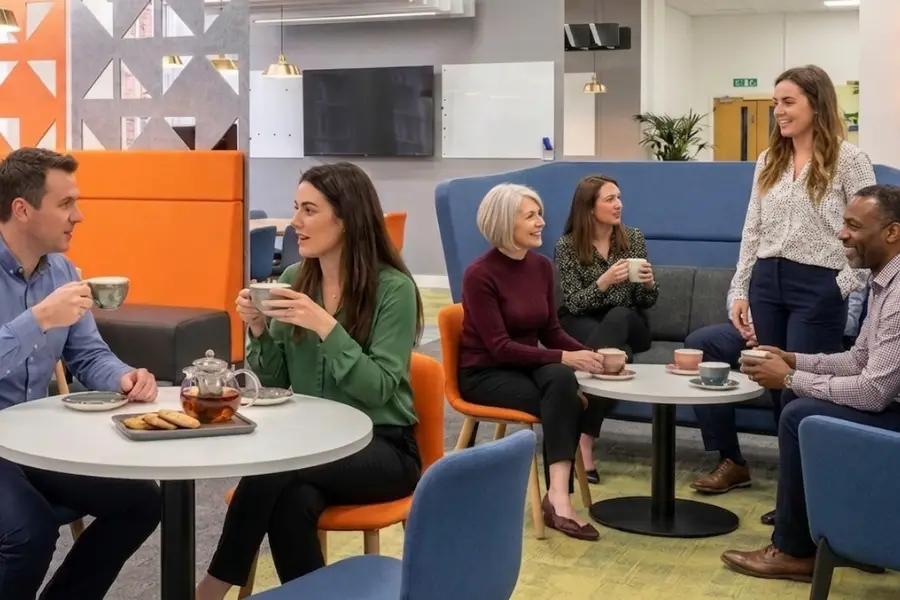
Most workplaces are still shaped around what feels structured, measurable and easy to justify. Desk numbers, meeting room ratios and capacity targets matter, but performance depends not just on capacity but on flow, interaction and how well the space supports how people really work.
This is where here at Form, we consistently see a gap emerge. Spaces that look exceptional, carefully considered and visually impressive, but that don’t quite work in practice. We often see breakout areas that were designed to encourage collaboration but remain underused because they don’t feel intuitive or comfortable. Often, kitchens are positioned as secondary spaces rather than central ones, limiting their ability to act as social anchors within the workplace and meeting rooms that are booked out, while the informal spaces aren’t being utilised to alleviate pressure.
Designing for how people actually work
On paper, everything has been accounted for but in reality, the workplace never quite comes together in the way it was intended. With the change in ways of working since 2020, hybrid working has made behaviour unpredictable and reshaped how people use the office day to day. Do the team feel like the office is a nice environment to come in and work from? We recently held a meeting with a client and they commented how ‘warm’ our office environment was, having never met the team before or been to our workspace.
When a space is designed around how people actually behave, not how we assume they behave, then the space becomes a place that team and professional partners, want to return to because it simply works. Designing with purpose means stepping back from the obvious. Understanding where people naturally gather can mean you make design decisions for your workplace that support natural, social behaviour and everyday collaboration, not just planned activity. These decisions may even challenge the norm and lead you to a less conventional design than you would have expected but be that for the better.
Sometimes that may result in giving more space to informal areas and less to formal ones or it may mean elevating spaces like kitchens or shared touchpoints, so they become central to the experience, rather than on the outskirts. Sometimes it may mean recognising that the most valuable space in the office is not the one that photographs best, but the one that people choose to use without thinking twice because without knowing it, that is where work is happening.
A simple way to rethink workplace design
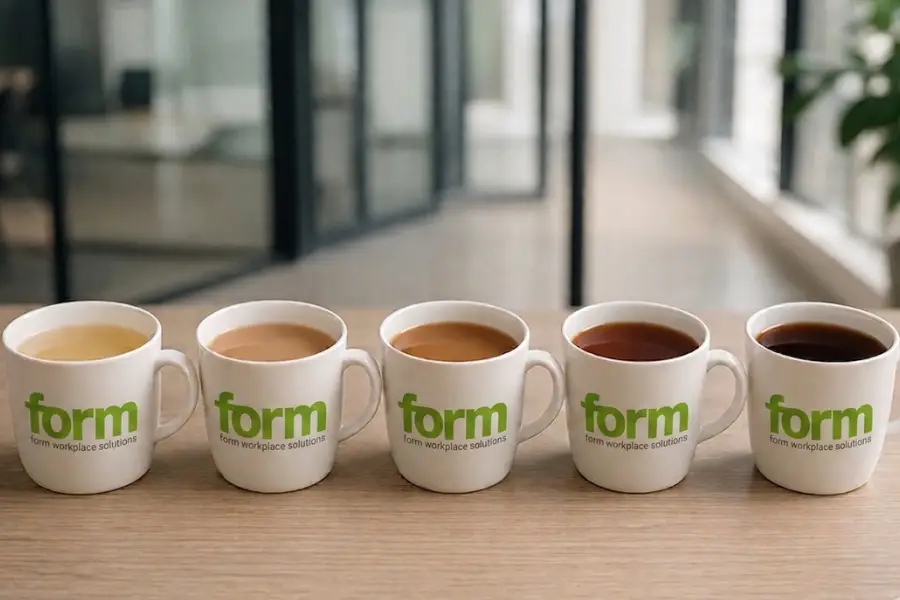
National Tea Day, this April 21st, a day that celebrates something as simple and routine as a cup of tea, serves as a useful reminder. If you want to understand whether your workplace is truly working don’t start with the obvious features, think about the small, everyday moments and where your team congregate naturally. This will tell you far more than the plan ever could and satisfy that guilty pleasure for people watching! Now let’s put the kettle on.
Form Workplace Solutions has a highly experienced design team with a long track record of bringing innovative concepts to office environments. Moreover, we offer feasibility studies to assist customer decision-making and planning. We’re bursting with ideas on how to bring future office designs to life.
If you’re looking for expert know-how and practical support, then get in touch by contacting Alex Ryan on 01494 464686 or email us at info@formws.co.uk.